📋 In This Article
Why the Sofa Should Come First
Most people furnish their living rooms in reverse order. They paint the walls first, lay the rug, hang the artwork, buy a coffee table, and then — last of all, almost as an afterthought — choose a sofa. The result is a room that functions reasonably well but rarely feels truly cohesive, because the most dominant piece of furniture was selected to fit within constraints already established by everything else.
Interior designers have understood for decades what most homeowners discover only through expensive trial and error: the sofa, as the largest single object in a living room, should define the room's design direction rather than conform to it. Its colour determines the entire palette's warmth or coolness. Its scale defines what other furniture can coexist comfortably. Its style sets the room's tonal register — whether formal or casual, minimal or layered, contemporary or traditional.
Leading with the sofa choice is not about limiting your options — it's about establishing a clear foundation from which every subsequent decision becomes significantly easier. When you know your sofa's upholstery colour is a warm, dusty taupe, the wall colour choice becomes obvious. When you know its style is mid-century modern with walnut legs, the coffee table material and the artwork framing style follow naturally. The sofa, chosen first and chosen well, becomes a design compass that guides the entire room.
🎯 The Sofa-First Method in Brief
Choose your sofa based on comfort requirements and style preference. Then extract your wall colour from a mid-tone in the upholstery. Let the sofa's style dictate leg materials and furniture silhouettes. Scale all other furniture relative to the sofa's dimensions. Add textural accessories that complement — never compete with — the sofa's upholstery character.
Building Your Room's Colour Story from the Sofa
The most enduring living room colour palettes are built around a single anchor piece — and in the living room, that anchor is always the sofa. Rather than choosing a sofa to match walls you've already committed to, consider choosing the sofa first and deriving your wall colour, rug tone, and accent palette from its upholstery.
This approach works because the sofa's colour is the one you'll be looking at most consistently — seated in front of it, looking around the room from it, and encountering it every time you enter the space. Getting the sofa colour right means getting the room's foundational tone right. Everything else adjusts around it with relative ease.
The Warm Neutral Foundation
Warm neutrals — cream, camel, taupe, warm greige — remain the most universally successful sofa colours precisely because they're so easy to build around. A warm neutral sofa pairs effortlessly with virtually any wall colour, accommodates seasonal accessory changes without conflict, and tends to appear more elegant over time as upholstery materials develop their character and patina.
With a warm neutral sofa as your anchor, the wall colour decision becomes a simple question of depth: light walls (warm white, pale cream, soft sand) create a tonal, enveloping atmosphere; mid-tone walls (warm grey, dusty sage, soft terracotta) add depth and drama; dark walls (deep charcoal, forest green, navy) create a high-contrast, gallery-like impact. All three approaches work beautifully with a warm neutral sofa — the choice depends entirely on the mood you're creating.
Statement Sofa Colour Strategies
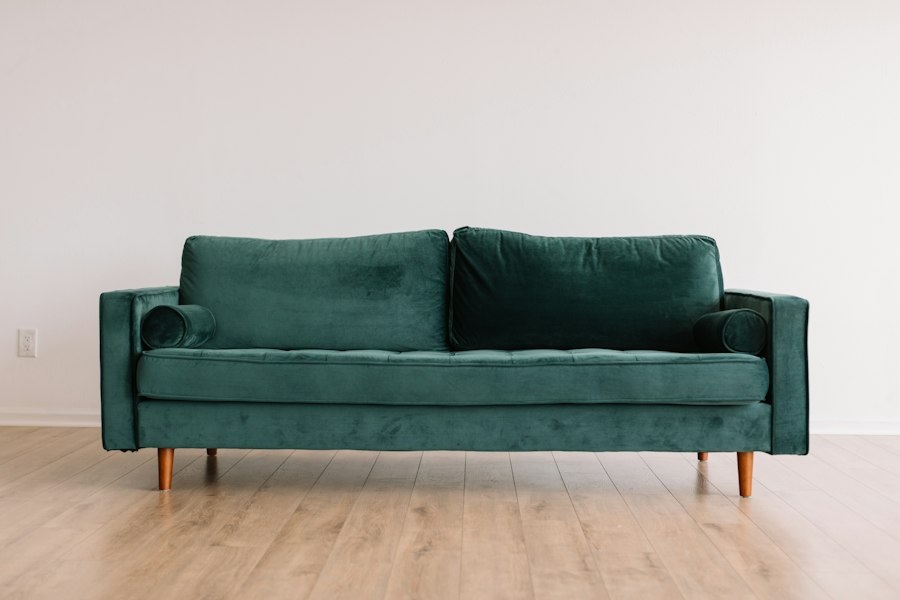
A sofa in a bold colour — deep blue, forest green, terracotta, warm burgundy — makes the strongest possible statement as a room's anchor. These choices require more careful colour management throughout the rest of the space, but when handled well, they produce rooms of extraordinary character and confidence.
The key principle for statement sofa colours is restraint everywhere else. A deep forest green velvet sofa sings against warm off-white walls, natural linen curtains, and simple oak furniture. It would feel chaotic paired with patterned wallpaper, colourful rugs, and competing accent furniture. The bolder the sofa, the quieter everything around it should be.
Laying Out the Room from the Sofa Outward
Once the sofa is placed, room layout becomes a process of working outward from that anchor — establishing the conversational grouping, the traffic paths, and the relationship between seating and room focal points.
The first decision is the sofa's orientation relative to the room's primary focal point — whether that's a fireplace, a television, a large window with a view, or an architectural feature. In most living rooms, this relationship is the room's organising principle: the sofa faces the focal point, and everything else arranges itself in service of this primary alignment.
The Floating vs. Wall-Placed Sofa
One of the most impactful decisions in living room layout is whether to float the sofa away from the wall or push it against it. Most people instinctively place sofas against walls, believing it maximises space. In most rooms — particularly those of average size or larger — the opposite is true.
A sofa floated 6–12 inches from the wall creates a seating zone with depth and presence. It allows a console table to be placed behind the sofa — a practical surface for lamps, books, or decorative objects that also visually anchors the sofa in the room. It creates walking space behind the sofa that feels intentional rather than accidentally unused. And it makes the entire room look more considered — the mark of deliberate design rather than default placement.
Building the Conversational Grouping
The sofa defines the anchor point of the conversational grouping — the arrangement of seating that enables comfortable face-to-face interaction. The ideal conversational distance between seats is 7–9 feet; beyond this, voices need to be raised and the arrangement loses its intimate quality.
For most three-seat sofas, the ideal complementary seating consists of two accent chairs placed at right angles to the sofa — not directly facing it. This creates an L or U-shape arrangement that feels naturally inclusive rather than formally confrontational. The coffee table placed centrally within this arrangement, accessible to all seats, completes the functional grouping.
Choosing a Consistent Style Direction
Design coherence doesn't require that every piece of furniture be from the same collection or period — it requires that all elements share a consistent visual language. The sofa's style establishes this language, and all subsequent choices should be legible within it.
A Scandinavian sofa with light wood legs and linen upholstery speaks a design language of natural materials, clean forms, and understated warmth. Other furniture in the room doesn't need to be Scandinavian, but it should be consistent with these values — natural materials, simple silhouettes, an absence of ornate decoration. A baroque mirror or an ornately carved coffee table would create a jarring visual conflict, while a simple ceramic lamp, a jute rug, and a clean-lined oak side table would feel entirely at home.
Mixing Periods Intelligently
Some of the most interesting living rooms mix furniture from different periods — a mid-century sofa alongside a traditional fireplace, a contemporary sectional in a Victorian terrace. This approach requires one clear unifying thread: typically a consistent colour palette, a shared material (brass, natural wood, linen), or a consistent level of visual simplicity that brings seemingly disparate pieces into dialogue.
The sofa's style should be the most contemporary or the most distinctive element in the room, with other pieces deferring to its visual authority. When the sofa is clearly the design anchor, other pieces can span a wider stylistic range without the room feeling incoherent — because all roads lead back to the sofa's established design language.
Lighting That Flatters the Sofa Area
Lighting is the design layer that makes or breaks the atmosphere of a living room sofa area, yet it's consistently the most underinvested element in home interiors. The majority of living rooms operate with a single overhead light source — which produces the least flattering, least comfortable, and least atmospheric illumination possible for a seating area.
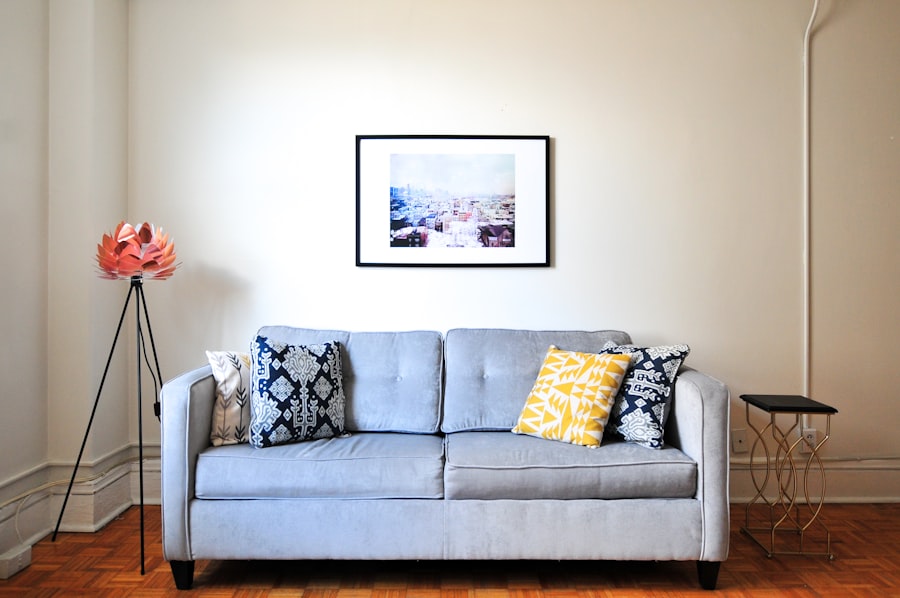
The remedy is the three-layer approach: ambient overhead light for general visibility, task lighting at sofa level for reading, and accent lighting for atmosphere and visual interest. A floor lamp positioned beside or behind the sofa provides the most natural, comfortable reading light. A table lamp on a side table creates an intimate pool of warmth. An overhead pendant or chandelier — ideally on a dimmer — handles ambient needs without dominating the other layers.
Bulb colour temperature is critical. Warm white (2700K–3000K) enhances the natural warmth of upholstery fabrics, creates flattering skin tones, and produces the amber quality of light that our brains instinctively associate with safety, comfort, and evening relaxation. Cool white or daylight bulbs — however practical in work spaces — undermine everything a well-chosen sofa is trying to achieve in a living room.
Layering Texture and Accessories
The final stage of designing around a sofa is the accessory layer — the cushions, throws, rugs, plants, and decorative objects that transform a furnished room into a finished home. This layer is where personal expression finds its fullest scope, and where the difference between a room that looks designed and one that looks lived-in is established.
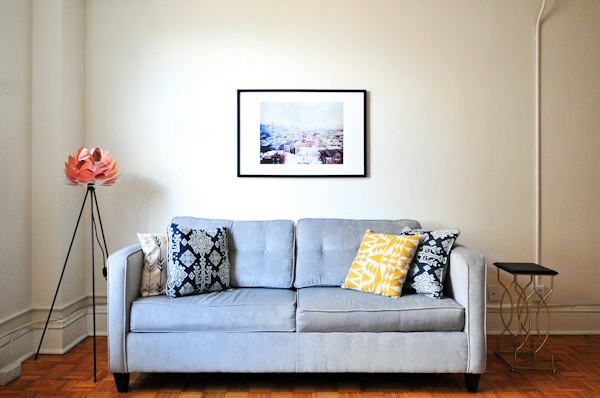
The most successful accessory compositions are built on contrast: a smooth velvet sofa softened with a chunky knit throw, a linen sofa warmed with a deep burgundy velvet cushion, a neutral-toned sofa energised by a patterned geometric cushion against a plain woven backdrop. Contrast creates visual interest; harmony creates coherence. The goal is both simultaneously.
Odd numbers work better than even for cushion arrangements — three or five creates a more natural, relaxed composition than two or four. Vary sizes: two larger cushions (22 inches) as the back layer, two medium ones (20 inches) in front, and one small accent or lumbar cushion (12×20 inches) at the centre. This hierarchy creates depth and prevents the flat, catalogue-like appearance of identically sized cushions in a row.
Common Living Room Design Mistakes to Avoid
❌ Rug Too Small
The most common and most impactful mistake. A rug that barely extends beyond the coffee table makes the entire furniture grouping look unanchored and the room feel smaller than it is. Always go larger than you think you need.
❌ All Furniture Against Walls
Pushing every piece against a wall doesn't create space — it creates an awkward void in the centre and makes furniture groupings feel disconnected. Float seating away from walls to define the room's zones.
❌ Mismatched Scale
A large sofa paired with a tiny coffee table, or a small loveseat with an oversized accent chair, creates visual imbalance that feels unsettled. Scale all furniture relative to the sofa's proportions.
❌ Single Light Source
Relying solely on overhead lighting flattens the room and undermines the warmth your sofa is designed to create. Layer multiple light sources at different heights for an atmosphere that transforms after dark.
Written by the Sofa Comfort & Living Guide editorial team. This article is for informational purposes only.